
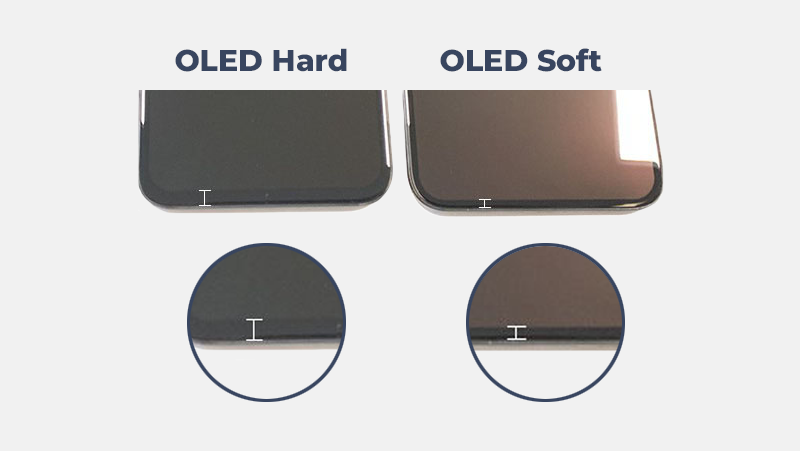
OLED (Organic Light Emitting Diode) technology has revolutionized the display industry with its superior image quality, flexibility, and energy efficiency. Among the various types of OLED displays, two popular categories are flexible OLED (Soft OLED) and rigid OLED (Hard OLED). While they share a common base, their differences in structure, application, and performance make them suitable for distinct use cases. This blog explores the key differences between these two types of OLED displays.
1. Structural differences
Soft OLED:
Flexible OLED displays are built on flexible substrates, such as plastic (polyimide), instead of rigid glass. This flexibility allows the display to bend, curl, or even roll without breaking. The components, including the organic layers and electrodes, are designed to withstand such deformations.
Rigid OLED:
On the other hand, rigid OLED displays are built on rigid glass substrates. This rigid structure provides greater durability against scratches and external pressure, but prevents them from being bent or flexed.
2. Flexibility and Design
Soft OLED:
Due to their flexible nature, Soft OLED displays are widely used in foldable smartphones, wearable devices, and other applications that require a curved or adaptable design. They enable innovative form factors and futuristic designs.
Rigid OLED:
Rigid OLED displays have a more traditional design, being flat and inflexible. They are commonly used in smartphones, TVs, monitors, and other devices where a rigid screen is sufficient.
3. Thickness and Weight
Soft OLED:
Flexible OLEDs are generally thinner and lighter than their rigid counterparts due to the plastic substrate. This characteristic is particularly advantageous for portable and wearable devices, where weight and size are critical factors.
Rigid OLED:
Although they are slightly thicker and heavier due to the glass substrate, rigid OLEDs still offer a compact form factor compared to older LCD technologies. However, they are less suitable for applications where a lightweight design is a priority.
4. Durability and robustness
Soft OLED:
The plastic substrate of flexible OLEDs makes them less prone to breakage compared to glass screens. However, they can be more susceptible to scratches and may require additional protective layers to ensure their durability.
Rigid OLED:
Rigid OLED screens are highly scratch-resistant, but can break upon impact due to the fragility of the glass. Protective cases or screen protectors are often necessary to increase the durability of devices with rigid OLED screens.
5. Cost and Manufacturing
Soft OLED:
The production process for flexible OLEDs is more complex and requires advanced materials and manufacturing techniques, resulting in higher costs. This is one of the reasons why devices with flexible OLED screens, such as foldable cell phones, tend to be more expensive.
Rigid OLED:
Rigid OLEDs are cheaper to manufacture due to their simpler production process and the wide availability of glass substrates. This makes them a cost-effective option for many consumer electronics devices.
6. Use cases and applications
| Resource | Soft OLED | Rigid OLED |
|---|---|---|
| Flexibility | Foldable, rollable, and adaptable designs | flat and rigid designs |
| Durability | Shatterproof; prone to scratches. | Scratch resistant; prone to breakage. |
| Cost | Higher manufacturing cost | More affordable to produce |
| Typical applications | Foldable phones, wearable devices, curved screens | TVs, monitors, standard smartphones |
Conclusion
Flexible and rigid OLED technologies each have specific advantages and limitations. Flexible OLED excels in applications requiring flexibility and innovative form factors, while rigid OLED is ideal for traditional flat-panel designs where cost-effectiveness and scratch resistance are priorities. Understanding these differences can help consumers and manufacturers make more informed decisions when choosing the display technology best suited to their needs.
With the continuous evolution of OLED technology, we can expect new innovations that will blur the lines between flexible and rigid screens, paving the way for more versatile and durable devices.


